Trypanosomes and trypanosomiasis / by A. Laveran and F. Mesnil. : Translated and much enlarged by David Nabarro.
- Charles Louis Alphonse Laveran
- Date:
- 1907
Licence: In copyright
Credit: Trypanosomes and trypanosomiasis / by A. Laveran and F. Mesnil. : Translated and much enlarged by David Nabarro. Source: Wellcome Collection.
Provider: This material has been provided by London School of Hygiene & Tropical Medicine Library & Archives Service. The original may be consulted at London School of Hygiene & Tropical Medicine Library & Archives Service.
113/568 (page 89)
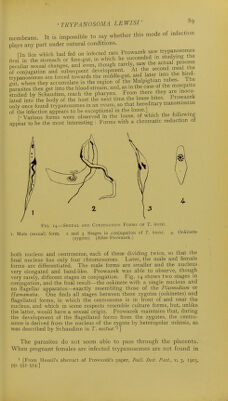
![membrane. It is impossible to say whether this mode of infection plays any part under natural conditions. [In lice which had fed on infected ^ats Prowazek saw trypa^^^^^^^ first in the stomach or fore-gut, in which he f'^^^^'^^'^!^^^^^^^ peculiar sexual changes, and even, though of conjugation and subsequent development. At the second meai i trypanosomes are forced towards the middle-gut, and later into the hind^ gut%here they accumulate in the region of the Malpigh>an tubes^ The parksites then get into the blood-stream, and, as in the case of J^e mosqmU^ studied by Schaudinn, reach the pharynx. From there they are inocu lated into the body of the host the next time the louse bites i^^owazek only once found trypanosomes in an ovum, so that hereditary transmission of the infection appears to be exceptional in the louse.] f^u^,,nn<r ['Various forms were observed in the louse, of which the following appear to be the most interesting : Forms with a chromatic reduction ot Fig. 14.—Sexual and Conjugation Forms of T. leivisi. I. Male (sexual) form. 2 and 3. Stages in conjugation of T. kwisi. (zygote). (After Prowazek.) 4. Ookinete both nucleus and centrosome, each of these dividing twice, so that the final nucleus has only four chromosomes. Later, the male and female forms are differentiated. The male forms are smaller and the nucleus very elongated and band-like. Prowazek was able to observe, though very rarely, different stages in conjugation. Fig. 14 shows two stages in conjugation, and the final result—the ookinete with a single nucleus and no flagellar apparatus—exactly resembling those of the Plasmodium or Hcemamceba. One finds all stages between these zygotes (ookinetes) and flagellated forms, in which the centrosome is in front of and near the nucleus, and which in some respects resemble culture forms, but, unlike the latter, would have a sexual origin. Prowazek maintains that, during the development of the flagellated forms from the zygotes, the centro- some is derived from the nucleus of the zygote by heteropolar mitosis, as was described by Schaudinn in T. twctua;.'^] The parasites do not seem able to pass through the placenta. When pregnant females are infected trypanosomes are not found in 1 [From Mesnil's abstract of Prowazek's paper, Bu//. Inst. Past., v. 3, 1905, PP- 55I-5S4-]](https://iiif.wellcomecollection.org/image/b21356208_0113.jp2/full/800%2C/0/default.jpg)