The climates and baths of Great Britain / / being the report of a committee of the Royal Medical and Chirurgical Society of London.
- Royal Medical and Chirurgical Society of London
- Date:
- 1895-1902
Licence: In copyright
Credit: The climates and baths of Great Britain / / being the report of a committee of the Royal Medical and Chirurgical Society of London. Source: Wellcome Collection.
Provider: This material has been provided by Royal College of Physicians, London. The original may be consulted at Royal College of Physicians, London.
76/668 (page 54)
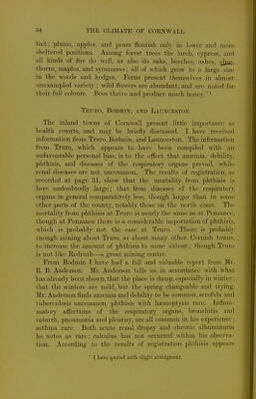
![teet; plums, apples, and pears flourish only in lower and more sheltered positions. Among forest trees the larch, cypress, and all kinds of firs do well, as also do oaks, beeches, ashes, elpis. thorns, maples, and sycamores; all of which grow to a large size in the woods and hedges. Ferns present themselves in almost unexampled variety; wild flowers are abundant, and are noted for their full colours. Bees thrive and produce much honey.” 1 Truro, Bodmin, and Launceston. The inland towns of Cornwall present little importance as health resorts, and may be briefly discussed. I have received information from Truro, Bodmin, and Launceston. The information from Truro, which appears to have been compiled with an unfavourable personal bias, is to the effect that anaemia, debility, phthisis, and diseases of the respiratory organs prevail, while renal diseases are not uncommon. The results of registration, as recorded at page 31, show that the mortality from phthisis is here undoubtedly large; that from diseases of the respiratory organs in general comparatively less, though larger than in some other parts of the county, notably those on the north coast. The mortality from phthisis at Truro is nearly the same as at Penzance, though at Penzance there is a considerable importation of phthisis, which is probably not the case at Truro. There is probably enough mining about Truro, as about many other Cornish towns, to increase the amount of phthisis to some extent; though Truro .is not like Redruth—a great mining centre. From Bodmin I have had a full and valuable report from Mr. R. B. Anderson. Mr. Anderson tells us, in accordance with what has already been shown, that the place is damp, especially in winter: that the winters are mild, but the spring changeable and trying. Mr. Anderson finds anaemia and debility to be common, scrofula and tuberculosis uncommon, phthisis with haemoptysis rare. Inflam- matory affections of the respiratory organs, bronchitis and catarrh, pneumonia and pleurisy, are all common in his experience; asthma rare. Both acute renal dropsy and chronic albuminuria he notes as rare; calculus has not occurred within his observa- tion. According to the results of registration phthisis appears ] I have quoted with slight abridgment.](https://iiif.wellcomecollection.org/image/b24758188_0078.jp2/full/800%2C/0/default.jpg)