John Locke, 1632-1704, physician and philosopher : a medical biography / with an edition of the medical notes in his journals.
- Kenneth Dewhurst
- Date:
- 1963
Licence: Attribution-NonCommercial 4.0 International (CC BY-NC 4.0)
Credit: John Locke, 1632-1704, physician and philosopher : a medical biography / with an edition of the medical notes in his journals. Source: Wellcome Collection.
143/374 (page 113)
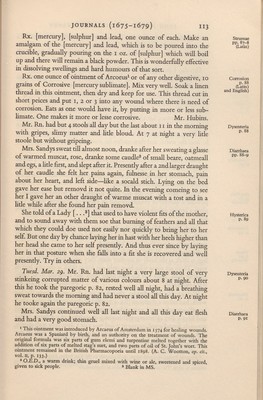
![Rx. [mercury], [sulphur] and. lead, one ounce of each. Make an amalgam of the [mercury] and. lead, which is to be poured into the crucible, gradually pouring on the 1 oz. of [sulphur] which will boil up and there will remain a black powder. This is wonderfully effective in dissolving swellings and hard, humours of that sort. Rx. one ounce of ointment of Arcoeus 1 or of any other digestive, 10 grains of Corrosive [mercury sublimate]. Mix very well. Soak a linen thread in this ointment, then dry and keep for use. This thread cut in short pcices and put 1, 2 or 3 into any wound where there is need of corrosion. Eats as one would have it, by putting in more or less sub limate. One makes it more or lesse corrosive. Mr. Hubins. Mr. Rn. had but 4 stools all day but the last about 11 in the morning with gripes, slimy matter and litle bloud. At 7 at night a very litle stoole but without gripeing. Mrs. Sandys sweat till almost noon, dranke after her sweating a glasse of warmed muscat, rose, dranke some caudle 2 of small beare, oatmeall and egs, a litle first, and slept after it. Presently after a 2nd larger draught of her caudle she felt her pains again, fulnesse in her stomach, pain about her heart, and left side—like a socald stich. Lying on the bed gave her ease but removd it not quite. In the evening comeing to see her I gave her an other draught of warme muscat with a tost and in a litle while after she found her pain removd. She told of a Lady [.. . 3 ] that used to have violent fits of the mother, and to sound away with them soe that burning of feathers and all that which they could doe used not easily nor quickly to bring her to her self. But one day by chance laying her in hast with her heels higher than her head she came to her self presently. And thus ever since by laying her in that posture when she falls into a fit she is recovered and well presently. Try in others. Tuesd. Mar. 2g. Mr. Rn. had last night a very large stool of very stinkeing corrupted matter of various colours about 8 at night. After this he took the paregoric p. 82, rested well all night, had a breathing sweat towards the morning and had never a stool all this day. At night he tooke again the paregoric p. 82. Mrs. Sandys continued well all last night and all this day eat flesh and had a very good stomach. 1 This ointment was introduced by Arcaeus of Amsterdam in 1574 for healing wounds. Arcaeus was a Spaniard by birth, and an authority on the treatment of wounds. The original formula was six parts of gum elemi and turpentine melted together with the addition of six parts of melted stag's suet, and two parts of oil of St. John's wort. This ointment remained in the British Pharmacopoeia until 1898. (A. C. Wootton, op. cit., vol. n, p. 133.) 2 O.E.D., a warm drink; thin gruel mixed with wine or ale, sweetened and spiced, given to sick people. 3 Blank in MS. Strumae pp.87-8 (Latin) Corrosion p. 88 (Latin) and English) Dysenteria p. 88 Diarrhaea pp. 88-9 Hysterica P. 89 Dysenteria p. 90 Diarrhaea p. 91](https://iiif.wellcomecollection.org/image/b20086283_0143.JP2/full/800%2C/0/default.jpg)